Executive Heart Health Assessment
The people most responsible for keeping the world running are often the last ones who take time to understand what is happening inside their own hearts. It's the paradox.
Cardiovascular disease remains the single leading cause of death among adults in the United States, and it does not discriminate by income, influence, or IQ. In fact, the very lifestyle that defines executive and professional success -- chronic stress, irregular sleep, extended periods of sedentary work, meals eaten standing over a sink or in a car -- creates a specific and compounding cardiovascular burden that is rarely fully appreciated until it is measured. What makes cardiovascular risk uniquely dangerous is its silence. The heart does not announce its vulnerability with a memo. Blood pressure rises without headaches. Arterial calcification accumulates without pain. Inflammatory markers climb while the person in question closes deals, leads board meetings, and coaches their child's weekend soccer team-- feeling, for all the world, completely fine. The tragedy-- and it is a genuine tragedy, one that plays out in emergency rooms across the country every single day -- is that the information needed to prevent the worst outcomes was almost always available. It simply was never gathered in time, because gathering requires infrastructure of care that most busy professionals have never been offered.
There is a particular kind of person who fits this lifestyle. You know them-- or perhaps you are one of them. They are the ones who show up early and leave late. The ones whose phones light up before the sunrise. The judge who has not taken a full lunch break in years. The surgeon who schedules everyone else's procedures but quietly defers their own. The executive who can cite quarterly earnings down to three decimal points but cannot tell you when they last had a meaningful conversation with their own physician. The creator who can't sleep thinking about advancing someone else's goals. These are not people who lack discipline. They are among the most disciplined people in any room. They are not people who do not care about their health-- most of them care deeply, and the quiet anxiety about it hums underneath every packed calendar. The issue is simpler and more human than that: the healthcare system, as it currently exists, was not designed for their lifestyle. It asks them to take half a day off for a routine visit, wait weeks for a specialist, return for a separate appointment for imaging, and a call back in two weeks for results. For someone managing a company, a courtroom, a hospital department, or a community organization, that fragmented choreography is not inconvenient--it is, in practical terms, impossible. And so it gets postponed. Season after season. Until one afternoon or one middle of the night, without warning, it is no longer possible to postpone.
1 in 3 cardiovascular events occur in people with no prior symptoms or diagnosis 80% of premature heart disease is preventable through early detection and lifestyle intervention 72% of executives report skipping or delaying recommended preventative care due to time constraints.
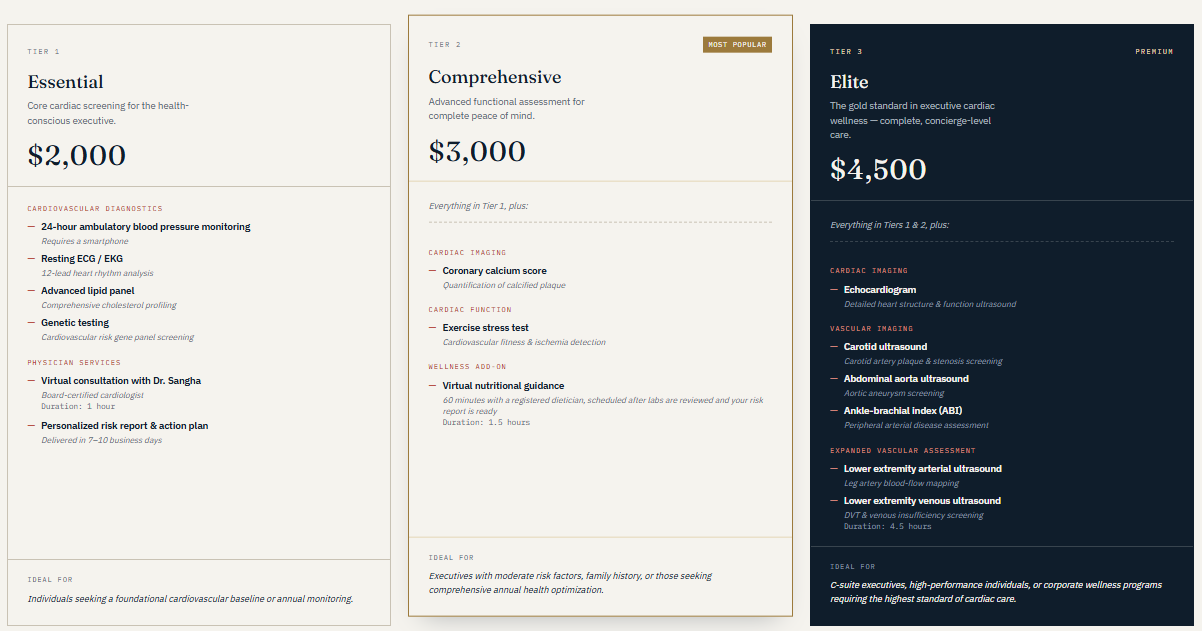
This is the gap our Executive Cardiovascular Evaluation is designed to close.
Three tiers of physician-led cardiovascular evaluation, built for the pace and risk profile of high-performance professionals.